
 View Specials
A toilet that won’t refill all the way is one of the most common calls we get, and the good news is that most of the time it’s a quick, inexpensive fix. When the tank doesn’t refill, the toilet won’t flush properly, and depending on the cause it can also quietly waste hundreds of gallons of water a day. The tricky part is that several different problems cause the same symptom, so the key is checking them in the right order.
Before you take the tank lid off, check the water shut-off valve on the wall behind the toilet. A valve that got bumped or partially closed is the single fastest thing to rule out, and it’s the first thing our plumbers check on a service call. If that’s fully open and the toilet still won’t refill, work through the seven causes below in order, from the simplest to the most involved.
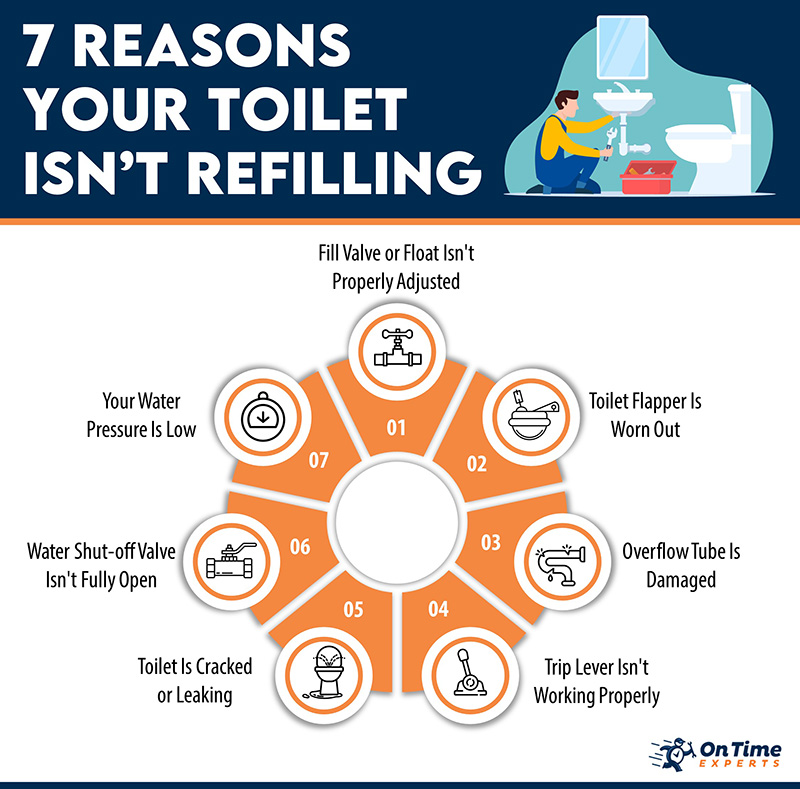
1. The Water Shut-Off Valve Isn’t Fully Open
This is always the first thing to check, because it takes ten seconds and it’s the most common “false alarm” we see. The shut-off valve is located on the wall or floor near the base of the toilet. If it’s been bumped, or someone closed it part way during cleaning or another repair, the tank won’t get enough water to refill completely.
Fix: Turn the valve counterclockwise until it’s fully open and watch whether the tank refills normally. If the valve was the problem, you’re done. If not, move on.
2. The Fill Valve or Float Isn’t Adjusted Properly
This is the most common mechanical reason a toilet won’t refill all the way. The fill valve lets water into the tank after a flush, and it’s controlled by a float. When you flush, the tank empties and the float drops, which opens the fill valve. As the tank refills, the float rises until it reaches a set point and shuts the valve off. If that float is set too low, the valve closes before the tank is full enough, and you get a weak flush.
This is also the adjustment homeowners most often get wrong in the other direction, setting it too high and causing the toilet to overflow into the overflow tube and run constantly. That’s why we get a fair number of calls right after a DIY attempt on this one.
Fix: You can usually adjust the float with a screw on top of the fill valve, or by sliding the float along its rod. Make small adjustments and test after each one. If you’re not confident where it should sit, this is a quick job for a plumber and cheaper than fixing an overflow afterward.
3. The Toilet Flapper Is Worn Out
The flapper is the rubber seal at the bottom of the tank that holds water in until you flush. Over time it hardens, warps, or develops a poor seal, and water leaks continuously from the tank into the bowl. When that happens, the tank may never reach a full water level, and you’ll often hear the toilet “phantom flush” or run on its own to top itself off.
A worn flapper is more than an annoyance. A leaking flapper commonly wastes around 200 gallons a day, which adds up to more than 6,000 gallons a month on your water bill. It’s the most common hidden water-waster we find.
There’s an easy at-home test: put a few drops of food coloring in the tank, wait about 20 minutes without flushing, and check the bowl. If color has seeped into the bowl, your flapper is leaking and needs replacing.
Fix: Replace the flapper. It’s an inexpensive part and one of the more DIY-friendly repairs, as long as you match the size and type to your toilet.
Water Waste Alert: A leaky flapper can waste over 6,000 gallons of water per month.
4. The Trip Lever or Chain Is Sticking
The trip lever is the arm connected to the flush handle, and a chain runs from that arm down to the flapper. When the lever or chain sticks, it can hold the flapper partly open, so water keeps draining out and the tank never fills. A chain that’s too short or tangled is a frequent culprit, and it’s an easy thing to miss.
Fix: Take off the tank lid and watch a flush cycle. If the lever sticks or the chain is binding, realign it, adjust the chain slack, or replace the lever arm if it’s bent or broken.
5. The Overflow Tube Is Cracked or Damaged
The overflow tube is the vertical plastic tube in the middle of the tank. It does two jobs: it routes a small stream of water into the bowl to refill it after a flush, and it prevents the tank from overflowing. If it cracks, water leaks straight through it into the bowl, so the tank can’t hold a full charge, and in a worse case it can lead to an overflow.
Fix: Inspect the tube for visible cracks or splits. A damaged overflow tube should be replaced promptly. This repair usually means swapping the flush valve assembly, which is where most homeowners decide to call a plumber.
6. The Toilet Is Cracked or Leaking
If you see standing water around the base of the toilet, you have a leak, and the toilet may be refilling frequently to make up for the lost water. The most common cause is loose bolts where the tank meets the bowl, which is an easy fix. The more serious cause is a crack in the porcelain itself, which usually means the toilet needs to be replaced.
Fix: Check and snug up the tank-to-bowl bolts first. If the bowl or tank is cracked, replacement is the only reliable fix. Standing water is also worth addressing fast because of the floor and subfloor damage it can cause.
7. Your Home Has Low Water Pressure
If you’ve ruled out everything inside the tank and the toilet still refills slowly or shuts off early, the issue may be your home’s water pressure, especially if it’s happening at more than one toilet. Every toilet needs a minimum supply pressure to fill correctly. When the whole house is low, no amount of tank adjustment will fix it.
Low pressure has several possible causes: a main shut-off valve that isn’t fully open, a faulty or misadjusted pressure regulator, or limescale buildup from hard water narrowing your pipes. When more than one fixture is affected, that’s the tell-tale sign it’s a whole-home issue rather than a single toilet.
Fix: Confirm your main shut-off valve is fully open and check the pressure regulator. If multiple fixtures are weak, have a plumber inspect the system for regulator problems or sediment and scale buildup.
When to DIY and When to Call a Plumber
Plenty of these are weekend-DIY repairs: opening the shut-off valve, swapping a flapper, adjusting a chain. Where we’d steer you toward a pro is anything involving the fill valve adjustment if you’re unsure (because overcorrecting causes overflows), a cracked overflow tube or porcelain, standing water at the base, or any whole-home pressure issue. Those are the situations where a quick fix done wrong tends to turn into a bigger, wetter problem.

If your toilet won’t refill, runs constantly, or has any other issue you’d rather not chase down yourself, On Time Experts can help. Our plumbers handle every kind of toilet repair, along with any other plumbing repair or installation you need across the Dallas-Fort Worth metroplex. Give us a call today.
Frequently Asked Questions
The most common causes are a water shut-off valve that isn’t fully open, a fill valve or float that’s set too low, or a worn flapper leaking water out of the tank. Start by confirming the shut-off valve behind the toilet is fully open, since that’s the fastest thing to rule out. If it is, check the float adjustment and test the flapper for a leak before moving on to less common causes like a cracked overflow tube or low household water pressure.
If your tank fills very slowly, shuts off early before reaching the full line, or the float sits noticeably low in the water, the fill valve or its float adjustment is the likely cause. You can often correct it by adjusting the float with the screw on top of the valve or by sliding it along its rod. Make small adjustments and test each time, because setting it too high causes the opposite problem: constant running and overflow.
That “phantom flush” almost always means water is slowly leaking from the tank into the bowl, forcing the toilet to top itself off. The usual culprit is a worn flapper that no longer seals, though a cracked overflow tube can do the same thing. Test the flapper by adding a few drops of food coloring to the tank and waiting 20 minutes without flushing. If color shows up in the bowl, replace the flapper.
Many of these repairs are DIY-friendly: opening the shut-off valve, replacing a flapper, or freeing a stuck chain. Adjusting the fill valve is doable too, but go slowly, since overcorrecting causes overflows. Call a plumber for a cracked overflow tube, a cracked tank or bowl, standing water around the base, or low water pressure affecting multiple fixtures. Those situations can turn into water damage if they’re not handled correctly.
A toilet with a worn flapper or other slow leak commonly wastes around 200 gallons a day, which is more than 6,000 gallons a month showing up on your water bill. That’s why a running or under-filling toilet is worth fixing quickly even when it seems minor. The repair is usually cheap; the wasted water is not.