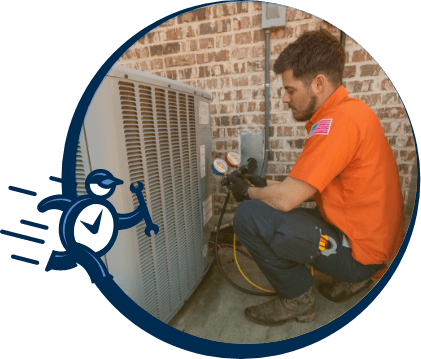
Professional AC Installation in Garland
If your current system is more than 10 years old, needs frequent repairs, or is driving up your energy bills, replacing it with a modern high-efficiency unit is often the smarter financial decision. The energy savings from a new system can offset replacement costs faster than most homeowners expect — especially when paired with available manufacturer rebates or off-season installation incentives. Our team at On Time Experts will run the numbers with you, walk through financing options, and explain what SEER ratings, two-stage compressors, and variable-speed blowers actually mean for your comfort and monthly costs in Garland.
At installation time, our AC team can also add indoor air quality upgrades — whole-house dehumidifiers, HEPA filtration, air purification systems, and UV lights. Our technicians handle the full installation and leave the home clean when they’re done.
Common reasons Garland homeowners install a new AC unit:
- The home has no existing AC system
- The current unit is 10 or more years old
- Frequent repairs are making the existing system too costly to maintain
- A higher-efficiency unit would meaningfully reduce monthly energy costs
- A home expansion or reconfiguration requires a new system layout
If you’ve recently moved to Garland or are scheduling a first-time installation, plan ahead of summer. The size and layout of your home determine the right system type, component placement, and whether existing ductwork can support the new unit. Getting that right from the start makes future maintenance and any eventual AC replacement straightforward. A properly installed system should run reliably for 15 to 20 years.
Types of Air Conditioning Systems We Install in Garland
Central AC uses a split system — an outdoor compressor/condenser unit and an indoor air handler — to cool your entire home through existing ductwork. It’s the most common system type in Garland homes and delivers consistent, whole-home cooling. Installation requires existing ducts or new duct construction.
A window air conditioner is a self-contained unit with all components enclosed inside a single housing, installed in a window frame or wall opening. Window units cool a single room and are best suited for supplemental cooling in spaces where extending ductwork isn’t practical.
Portable AC units are freestanding and require no permanent installation. They exhaust heat through a window duct and can be moved between rooms as needed. Portable units are less efficient than fixed systems and work best as supplemental cooling rather than a primary solution.
Mini-split systems pair one outdoor compressor with one or more indoor air handlers mounted in individual rooms or zones. Each zone is controlled independently, which makes them highly efficient for homes without existing ductwork, room additions, garages, or any space where zone-by-zone temperature control matters.
Smart AC systems — whether central, mini-split, or window units — connect to your home’s Wi-Fi and can be monitored and adjusted remotely from a phone or tablet. Features typically include scheduling, real-time temperature control, and energy usage tracking, giving homeowners more control over comfort and operating costs.
Through-the-wall units are permanently installed through an exterior wall opening, which frees up window space while providing dedicated cooling for a single room. They’re a good option for bedrooms, home offices, or spaces where a window unit isn’t practical. Installation requires cutting a wall opening sized to the unit.
Geothermal systems use underground loop fields to exchange heat between your home and the earth, where ground temperatures remain stable year-round. In summer, heat is transferred from your home into the ground. In winter, the process reverses to bring heat in. Geothermal systems have a higher upfront installation cost but can significantly reduce long-term heating and cooling expenses.
Evaporative coolers (also called swamp coolers) pull outside air through water-saturated pads, cooling it through evaporation before circulating it through the home. They consume significantly less energy than compressor-based systems, but they add moisture to the air and perform best in dry climates. They are generally not recommended as a primary cooling solution in the Dallas-Fort Worth area due to high summer humidity levels.



 View Specials