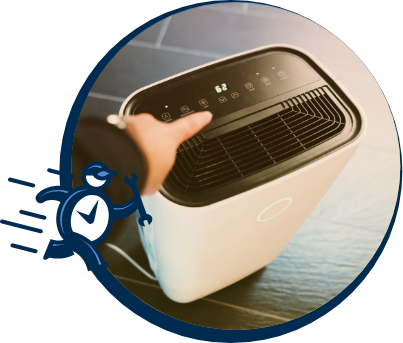
Whole-Home Humidity Control for Garland Homes
Living in North Texas means dealing with big swings in temperature and moisture. Warm outdoor air carries more moisture, and that humidity can make its way indoors every time doors open, through normal air leakage, and during everyday activities like cooking and showering.
Your air conditioner removes some of that moisture while it runs. The problem is that temperature and humidity do not always move together. Your AC may satisfy the thermostat before it has had enough runtime to remove as much moisture as your home needs.
That can leave you with a house that is technically cool but still feels sticky.
A whole-home dehumidifier provides dedicated humidity control instead of asking the AC system to handle the entire job. If you want a deeper explanation of why that happens, read our guide to why your AC alone may not be enough for Texas humidity.
Signs Your Garland Home May Need a Dehumidifier
High indoor humidity is not always obvious. Sometimes you notice the air feels heavy. Other times, the first clues show up around the house.
You may benefit from additional humidity control if you notice:
- Rooms that feel sticky or clammy even when the AC is running
- Musty odors that keep returning
- Condensation collecting on windows or other surfaces
- Bathrooms or other rooms staying damp for a long time
- Your AC running frequently without the house feeling comfortable
- Moisture collecting in closets or other less ventilated areas
- Visible mildew in areas that stay humid
- You keep lowering the thermostat because the house still feels warm
Those symptoms do not automatically mean you need a whole-home dehumidifier. Problems with AC sizing, airflow, ductwork, ventilation, or other conditions can also contribute to indoor humidity. That is why we start by looking at what is happening in your home.
Whole-Home Dehumidifier vs. Portable Dehumidifier
Portable dehumidifiers can be useful when moisture is limited to one small area. But they are designed to treat the room around them, not an entire Garland home.
A whole-home dehumidifier is connected to the HVAC system and designed to manage moisture across a much larger area. Instead of moving a portable unit from room to room, emptying a reservoir, and trying to balance several different spaces, you get a centralized humidity-control solution.
Whole-home systems can be especially useful when humidity is affecting multiple rooms or when the problem returns throughout the warmer months.
How a Whole-Home Dehumidifier Works
A whole-home dehumidifier pulls humid air through the system, removes excess moisture, and sends drier air back into the home. The collected moisture is drained away rather than stored in a bucket that you have to empty.
The system can work alongside your air conditioner instead of replacing it. Your AC continues to control indoor temperature, while the dehumidifier focuses more directly on moisture.
This separation can be useful during conditions where the home needs additional dehumidification even though it does not need much more cooling.
Whole-Home Dehumidifier Installation in Garland
Installing a dehumidifier is not as simple as choosing the largest unit and attaching it to the ductwork. The equipment needs to be matched to the home and installed in a way that works with the existing HVAC system.
When we evaluate a Garland home for dehumidifier installation, we look at factors such as:
- Home size and layout
- Current indoor humidity
- HVAC system capacity and configuration
- Airflow and ductwork
- How often and where humidity problems occur
- Drainage options for collected moisture
- Your family’s comfort goals
Our goal is to recommend enough dehumidification for the home without unnecessarily oversizing the equipment.
Choosing the Right Size Dehumidifier
Whole-home dehumidifiers come in different capacities, often based on how much moisture they can remove from the air over a set period of time.
Home size matters, but square footage is not the only consideration. A tightly sealed home may behave differently from an older home with more outdoor-air infiltration. The existing HVAC system, number of occupants, moisture sources, and severity of the humidity problem can all affect what size makes sense.
That is why we prefer to evaluate the actual house instead of telling every Garland homeowner that the same system will work.
What Changes After You Add Whole-Home Dehumidification?
The biggest change many homeowners notice is simply that the house feels more comfortable at the same thermostat setting.
When indoor air is less humid, it can feel less sticky and heavy. You may not feel the same need to keep lowering the thermostat just to feel comfortable.
Better humidity control can also help with:
- Persistent damp or musty conditions
- Condensation caused by excessive indoor moisture
- Rooms that feel uncomfortable even when they are cool
- Moisture conditions that can encourage mildew growth
- Overall indoor comfort during humid North Texas weather
A dehumidifier is not a cure-all for every indoor air quality problem, but it can be an important part of a broader humidity and indoor air quality strategy.
Can a Dehumidifier Help Your AC?
It can help your AC focus on what it is primarily designed to do: control temperature.
When indoor humidity is high, homeowners often compensate by setting the thermostat lower because the house still feels uncomfortable. Dedicated humidity control may help the home feel more comfortable without relying entirely on lower temperature settings.
That does not mean a dehumidifier fixes an air conditioner that is too small, poorly maintained, or malfunctioning. If your AC cannot maintain the thermostat setting, we need to look at the cooling system itself.
But when the temperature is under control and the house still feels humid, a whole-home dehumidifier may be the missing piece.



 View Specials